
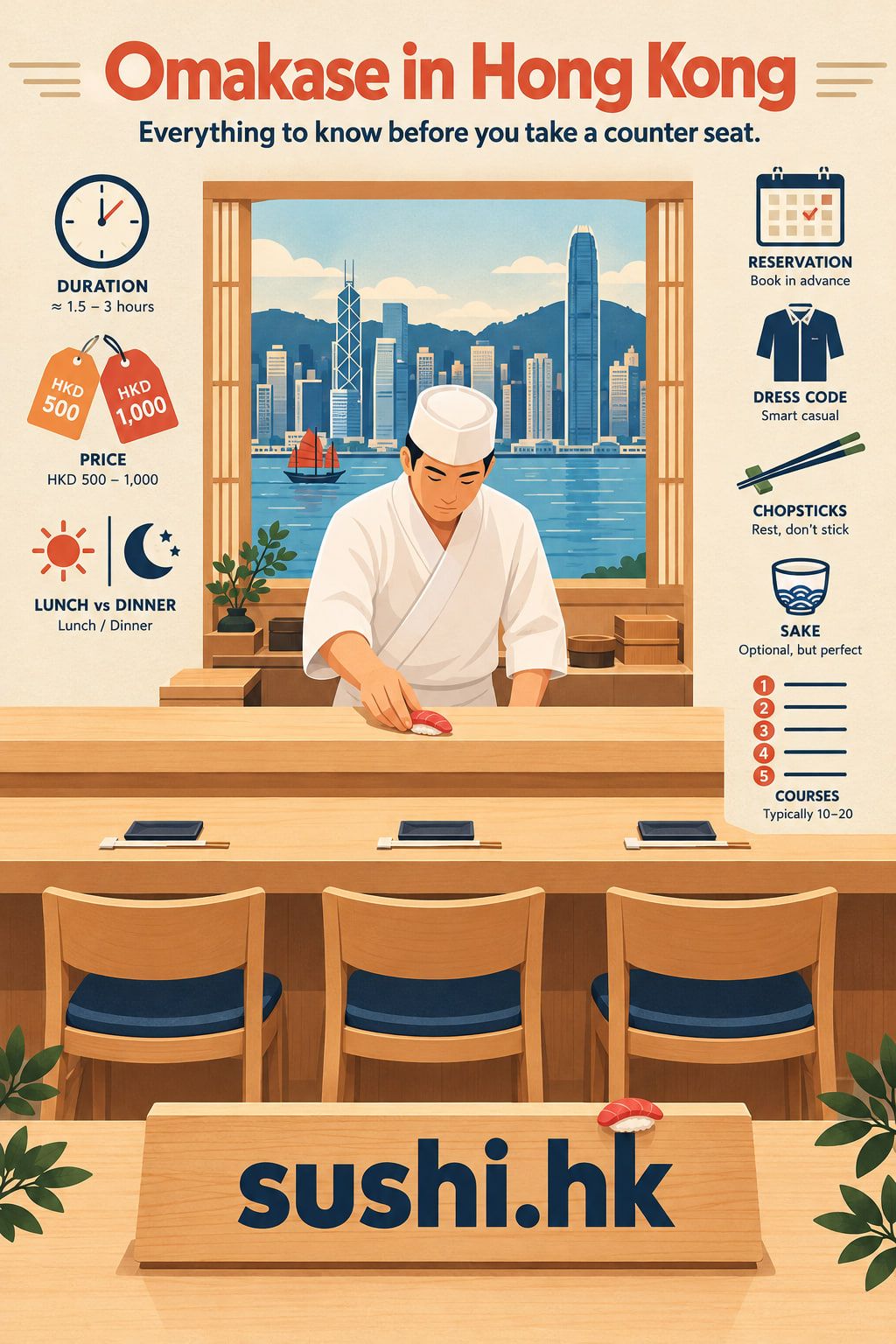
Omakase in Hong Kong
Everything to know before you take a counter seat.
Omakase in Hong Kong
Omakase means, roughly, ""I leave it up to you."" You hand the chef control of the menu, and the meal is built from what was bought that morning rather than from a printed list. At a Hong Kong sushi counter that means a few appetisers, then nigiri served one piece at a time, each eaten within seconds of being placed in front of you.
Hong Kong has more credible omakase counters than any city outside Japan, which makes the real question not whether to go but which tier, which room and which sitting. This guide answers all three, then covers the etiquette, timing and money questions that put most people off booking.
What omakase costs in Hong Kong. Casual counters start around HKD 398. The value sweet spot runs HKD 580 to 980 at lunch. Serious dinner counters sit at HKD 1,380 to 3,000. The apex is HKD 2,250 at lunch and HKD 4,000 at dinner at Sushi Shikon. Add the standard 10% service charge to every figure, and remember that lunch is commonly 40% to 60% cheaper than dinner at the same restaurant.
How an omakase meal actually works
You arrive at a fixed time, sit at the counter, and the chef takes over. Most meals open with one or several appetisers, then move through the nigiri in a deliberate order — lighter white fish and shellfish first, richer cuts such as chutoro and otoro later, with cured or simmered pieces placed where they reset the palate. Rolls, tamago, soup and a simple dessert close it.
The format rewards trust and punishes improvisation. The kitchen buys fish against confirmed covers, often from a single morning delivery, so there is no printed menu to choose from and little room to change course once you sit down. That is why allergies and dislikes belong in the booking, not the conversation at the counter. The full walkthrough, from arrival to the final piece, is in what is omakase and how does it work.
Most serious Hong Kong counters work in the Edomae tradition from old Tokyo, which means the fish is treated rather than simply sliced: tuna aged for days, white fish cured with kombu, mackerel salted and vinegared, clams simmered. The rice is seasoned with vinegar and served near body temperature, and each piece arrives already brushed with a soy glaze called nikiri. What that tradition is and how to recognise a serious counter is explained in Edomae style omakase explained.
The best omakase counters in Hong Kong
Sushi Shikon on the seventh floor of The Landmark Mandarin Oriental is the benchmark: three MICHELIN stars held since 2014, an eight-seat main counter, a separate six-seat private counter, and published pricing of HKD 2,250 at lunch and HKD 4,000 at dinner before service. Lunch is one seasonal appetiser, eight pieces, soup and dessert; dinner adds five or six appetisers and around ten pieces.
Sushi Wadatsumi at Shop 607, 6/F, K11 MUSEA holds one star and serves lunch and dinner daily in an orthodox Edomae style, having begun as the Hong Kong branch of Tokyo's Ginza Iwa. Sushi Takeshi at The Mira on Nathan Road is newly starred, with a chef trained at Wadatsumi and at Ginza Iwa. Kanesaka on the 5th floor of CCB Tower in Central, the Hong Kong counter of Tokyo's Sushi Kanesaka, is rated 4.9 and is described by diners as seasoning more boldly than most local counters.
Sushi Hare at 29–31 Bridges Street in Sheung Wan is the connoisseur's room, where chef Motoharu Inazuka adjusts the shari to suit each piece of seafood; lunch has been reported at HKD 900 to 980, and it is effectively invitation-preferred. Udatsu Sushi in the heritage Stable Block at FWD House 1881 offers the most atmospheric setting in the city.
The full ranking, with strong alternatives across every district and price band, is in the best omakase in Hong Kong.
Star ratings change every year. September 2026 coverage reports that Sushi Saito lost its star in the latest selection while Sushi Takeshi gained one. Reputation also moves with chefs: one diner who returned to a well-regarded hotel counter on New Year's Eve 2025 reported a chef change and felt a HKD 3,080 menu did not justify the price. Read recent reviews, not lifetime averages.
What each price band buys
Under HKD 500, you get a casual counter and a short, competent sequence of eight to ten pieces in thirty to forty-five minutes. Uogashi Nihonichi, at Central Market and at AIRSIDE in Kai Tak, has listed compact omakase from around HKD 398, backed by a Japanese parent group that holds auction rights at Tsukiji. The trade is comfort and ceremony: that AIRSIDE branch began as a standing bar, and diners describe its later seating as functional rather than comfortable.
Between HKD 500 and 1,000 is where most diners should spend. Sushi Sadayama on Wing Lok Street runs lunch around HKD 588 with a 4.9 rating from more than 220 reviews, and diners describe seared mackerel with shiso, thick-cut akagai, chutoro and generous uni. Gonpachi on the 28th floor at No. 1 Peking Road offers HKD 580 and 880 lunches with a 270-degree harbour view, Sushi Zinc in Shau Kei Wan lists lunch at HKD 880, and Mikasaya in Causeway Bay has run Edomae omakase at fair prices since 2023.
Above HKD 1,500, what rises is not technique alone but scarcity: aged bluefin, premium uni, rare shellfish, smaller rooms and more staff per guest. Returns diminish sharply from that point. The tier-by-tier breakdown is in omakase under HKD 500 and HKD 1,000: what you get at each level, and the reasons behind four-figure pricing are in why good sushi is expensive.
Lunch or dinner
At the same restaurant, with the same chef and the same morning's fish, lunch typically costs 40% to 60% less than dinner. Sushi Shikon publishes HKD 2,250 against HKD 4,000. Sushi Zinc lists HKD 880 against HKD 2,400. Gonpachi runs HKD 580 and 880 against HKD 1,380.
What you give up is appetisers, a couple of pieces, some premium ingredients and time. What you keep is the kitchen, the rice, the counter and the technique. For a first omakase, lunch is the rational choice; for an anniversary, dinner earns the difference. The worked comparisons are in lunch versus dinner omakase: price difference explained, and value lunches in the business district are gathered in Central lunch omakase sets under HKD 800.
How long it takes, and why timing matters
Most Hong Kong omakase menus run ten to twenty courses. Allow about 90 minutes at lunch and up to two hours at dinner, and never book anything immediately afterwards. The course count on a menu is less useful than it looks, because restaurants count differently — a twenty-course dinner that includes cooked dishes can be shorter than a twelve-course menu of generous nigiri.
The number that really matters is the sitting window. Sushi Sadayama serves exactly noon to 1:30pm and 7pm to 8:30pm, closed Wednesday; Uehara in Causeway Bay has listed noon to 2pm and 6:30pm to 9pm, closed Monday. Arrive fifteen minutes late to a ninety-minute sitting and you lose courses. The structure by price band and how to plan around it is in how many courses an omakase has and how long it takes.
Etiquette at the counter
Every convention exists because the food is perishable by the second and the room is small. The single rule that matters most is to eat each piece within a minute of it being placed in front of you. Fingers or chopsticks are both correct. Do not add soy sauce to a piece that arrives glossy, because the chef has already brushed nikiri on it. Eat pickled ginger between pieces, not on top of them, and ask before photographing the chef or other guests.
Conversation is welcome at most Hong Kong counters — asking what a fish is and where it came from is the best opening line in the room — but a chef working eight covers is cooking, not hosting. The full set of conventions is in omakase etiquette: what to do at the counter, with the hands-or-chopsticks question settled in sushi etiquette: hands or chopsticks.
Dress is rarely an issue. Smart-casual works everywhere, from a HKD 588 lunch to a four-figure hotel dinner. The practical constraints matter more: counter seats are assigned, some casual counters were designed for standing, storage is usually a hook, and strong perfume is the one genuine faux pas. Seating, accessibility and the questions to ask when booking are in omakase dress code and seating rules.
Substitutions, allergies and dietary needs
You can request changes, but timing decides everything. Tell the restaurant when you book and most counters will work around an allergy or a strong dislike; raise it once you are seated and your options shrink to refusing a course. Diners report chefs preparing alternatives when warned — one counter made a different course for a guest who could not eat uni — but an omitted course does not reduce the bill.
If restrictions are significant, change the format rather than the menu. A kappo or kaiseki-style omakase interleaves cooked courses and adapts far more easily than a pure nigiri counter. What kitchens will and will not do is in can you request substitutions at omakase, and specific needs are covered in shellfish allergy at sushi restaurants, sushi for pregnant women and vegetarian and vegan sushi in Hong Kong.
Omakase, kaiseki and kappo
Omakase is a booking arrangement; kaiseki is a cuisine. Ordering omakase means ""chef, you choose"", and it can be applied to sushi, kappo, teppanyaki or kaiseki. Kaiseki is a formal multi-course tradition rooted in the tea ceremony, where season governs composition and courses follow recognised categories — clear soup, sashimi, grilled, simmered, fried, rice. Kappo sits between the two: chef-led and counter-based, but spanning raw and cooked courses.
In Hong Kong, Zuicho at The Mercer in Sheung Wan has held one MICHELIN star since 2021 for kappo omakase, and Mu at H Zentre in Tsim Sha Tsui is another kappo-style room rated 4.9. If someone at the table eats little raw fish, one of these is usually the better booking. The distinctions, and which to choose when, are in kaiseki versus omakase: what is the difference, with the wider Japanese dining picture in Japanese food beyond sushi.
Language, and whether you need Japanese
You do not. Most premium counters serve an international clientele, and chefs and floor staff routinely explain courses in English. The practical question is less whether anyone speaks English than whether the chef will talk to you through the meal. Rooms where English-language reviews name individual chefs and describe detailed explanation of each piece include Udatsu Sushi, Omakase IKI on Chatham Road, Hashibami in Hung Hom and Kanesaka in Central.
Put allergies in writing rather than relying on a spoken note, and use WhatsApp where a restaurant offers it. The counters and the approach are in best omakase counters with English-speaking chefs, and a short vocabulary that covers most of what you will hear is in Japanese sushi menu words and how to pronounce them.
Tipping and the service charge
No additional tip is expected. Hong Kong restaurants add a 10% service charge to the bill as standard, so a quoted HKD 588 lunch costs HKD 646.80 in practice. Anything beyond that is discretionary — a small cash gesture for exceptional service or a genuine off-menu accommodation is appreciated, but not required. Restaurants do not publish how the service charge is distributed, which is why some diners still leave a little extra.
Do not add a 15% or 20% tip on top out of habit; it is not the local norm. The full answer, including how to leave something without awkwardness, is in do you tip at omakase restaurants.
Booking the hard ones
Booking is the real obstacle at the top counters. Seats are released either monthly for the following month or on a rolling 30-day window, usually at 9am or 10am Hong Kong time, and prime slots can clear in minutes. Deposits and card guarantees are standard, and penalties are enforced: one starred counter has charged 50% for cancellation within 48 hours, and others require changes two days ahead.
Four tactics genuinely improve your odds: book lunch rather than dinner, take a Tuesday or Wednesday, book for two since counters fill in pairs, and ask about the private counter, which is often less contested. A hotel concierge is a real advantage if you are staying in the property. The release rules and the step-by-step plan are in how to book a sushi restaurant in Hong Kong, and if nothing is available, the rooms listed in hidden gem sushi restaurants are considerably easier to secure.
Choosing your first omakase
Start at lunch, at a mid-tier counter, in a district close to where you are staying. That combination removes the three things that make a first omakase stressful: a four-figure bill, a formal room and a cross-harbour journey against the clock. Sushi Sadayama in Sheung Wan, Gonpachi in Tsim Sha Tsui and Mikasaya in Causeway Bay all fit that brief.
If the occasion matters more than the learning experience, a private counter at a top room is worth the booking effort; see romantic sushi and omakase for dates and anniversaries. If you are dining alone, the counter format is the most comfortable solo meal in the city, covered in solo dining sushi counters. And if you want to know what to drink alongside, sushi and sake pairing in Hong Kong covers the styles and the bars. For broader guidance on the fish itself, start with otoro, chutoro and akami explained and the seasonal Japanese fish calendar.
Common questions
How much does omakase cost in Hong Kong?
From about HKD 398 at a casual counter to HKD 4,000 at Sushi Shikon's dinner, before the 10% service charge. The value band of HKD 580 to 980 at lunch is where most diners get the best experience per dollar.
Which is the best omakase in Hong Kong?
By inspector recognition, Sushi Shikon. For value, Sushi Sadayama's lunch at around HKD 588. For a view, Gonpachi.
Is omakase worth it for a first-timer?
Yes, at lunch and at a mid-tier counter. Start there rather than at a four-figure dinner.
How far ahead should I book?
Six to eight weeks for the top counters, following the monthly or 30-day release rule. Mid-tier counters often need only a week or two.
Can I go if I do not eat raw fish?
Choose a kappo or kaiseki menu instead, which mixes cooked and raw courses, and tell the restaurant when you book.
Compiled by our editorial team from the MICHELIN Guide Hong Kong & Macau, official restaurant menus and reservation terms, Hong Kong Tourism Board listings, current venue listings with ratings and trading hours, diner reviews, and recent Hong Kong dining coverage. Last reviewed September 2026. Star ratings change annually; recent reporting indicates a newly awarded star for Sushi Takeshi and the reported loss of Sushi Saito's star. Prices differ between sources for some restaurants, are indicative, and exclude the 10% service charge unless stated. Diner reviews are individual opinions rather than verified facts. We do not claim first-hand visits to every venue, and no restaurant paid for inclusion. General information only, not medical or dietary advice.
"