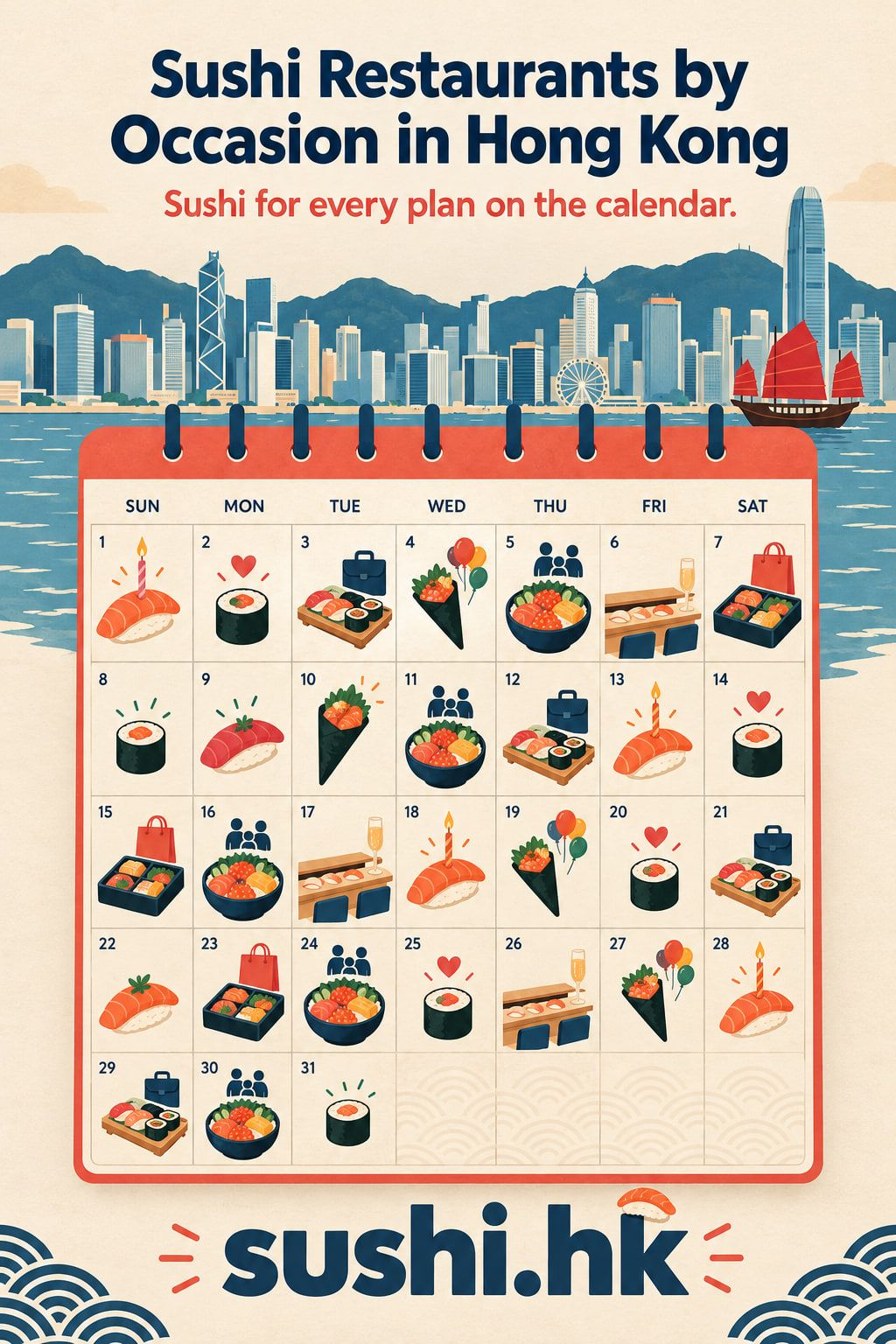
Sushi Restaurants by Occasion in Hong Kong
Sushi for every plan on the calendar.
Sushi Restaurants by Occasion in Hong Kong
The best sushi restaurant in Hong Kong is the wrong choice for half the evenings you will want sushi. An eight-seat omakase counter is perfect for an anniversary and hopeless for a family of five. A conveyor belt is ideal for a child's birthday and a poor place to close a deal. A silent Edomae room rewards a solo diner and punishes a first date.
So this guide starts from the occasion rather than the restaurant. For each one it explains what the room needs to do, names places that do it well, and points to the full guide.
Match the format to the occasion before you match the restaurant. A private counter suits anniversaries and confidential meetings. A table with cooked dishes suits families and mixed groups. A seated counter suits solo diners and serious eaters. A belt chain or catering set suits children and crowds. An izakaya suits first dates and after-work drinks. Get that right and almost any good restaurant in the category will work.
Dates and anniversaries
The counter layout matters more than the food. A straight counter puts you shoulder to shoulder facing a chef; a corner seat lets you turn towards each other; a private counter removes the audience entirely. Formal Edomae rooms are also quiet enough that every sentence carries, which suits a couple of twenty years and unnerves a couple of three weeks.
For a milestone, Sushi Shikon at The Landmark Mandarin Oriental is the obvious booking: three MICHELIN stars and, crucially, a separate six-seat private counter alongside the main eight-seat room. Udatsu Sushi in the restored Stable Block at FWD House 1881 gives the evening a sense of arrival that a tower-block dining room cannot, and one recent diner described staff going beyond the menu with a special treat for a birthday dinner. Sushi Kumogaku in Central keeps a private room behind its hinoki counter, and Gonpachi on the 28th floor at No. 1 Peking Road offers a 270-degree harbour view at a fraction of apex prices, with omakase from HKD 580 at lunch.
For a first date, choose flexibility over reverence. Aqua on the 17th floor of H Zentre runs Japanese and Italian menus with harbour views and serves until 1am at weekends; Zoku at The Hari in Wan Chai has a terrace and a Japanese-ingredient cocktail list. Both let you order a second drink or leave early without disrupting a timed sequence. The full shortlist, with booking advice and the mistakes to avoid, is in romantic sushi and omakase for dates and anniversaries, and the view-led options are compared in sushi restaurants with harbour views and Tsim Sha Tsui sushi with a view of Victoria Harbour.
Birthdays and celebrations
A birthday needs a room that can acknowledge the occasion without turning it into a spectacle, and a kitchen that knows in advance. Tell the restaurant when you book, not on arrival, and ask what they can do — a discreet dessert plate works far better at a small counter than a song.
For a couple, a private counter or corner seat at an omakase room is the simplest answer. For a small group on a budget, HAN DINING at Shop 30, Level 11, Langham Place in Mong Kok has run a two-person lunch set at HKD 298 in a calm, refined room that reviewers say couples use for birthdays — though note it closes on Sundays. For a larger group, a table-service restaurant with a private dining room is the right format: Honjo on Queen's Road West in Sheung Wan has a private room, a kids' menu, high chairs and a rating of 4.7 from more than 1,200 reviews.
Venues sorted by party size and budget are in sushi restaurants for birthday celebrations. If you are hosting at home instead, a platter or a temaki station is less work than it sounds — see sushi platters for parties, weddings and celebrations and the home sushi party plan.
Festival menus are a separate category, not a scaled-up dinner. One diner who returned to a well-regarded hotel counter on New Year's Eve 2025 paid HKD 3,080 per person, reported that the head chef had changed since their previous visit, and felt the meal did not justify the price. For Christmas, New Year, Valentine's Day and Chinese New Year, ask exactly what the special menu includes, read the most recent reviews rather than the lifetime average, and book weeks earlier than usual.
Business lunches and client meals
A client meal needs conversation, privacy and a predictable finish time, which rules out belt chains and most eight-seat counters. What works is table separation, a screened or private room, and a set menu that arrives without negotiation.
In Central, Kanesaka on the 5th floor of CCB Tower is a serious Edomae counter with a lunch service from noon to 3pm, suited to a meeting where the food is the point. In Causeway Bay, Hana Sakazuki has run since 2004 and serves sashimi, sushi and teppanyaki in a polished room that handles mixed tastes. In East Kowloon, Tenohira Sushi in Camel Paint Building is unusually spacious for Hong Kong, with bamboo-screened sections that make it viable for a work conversation, and Yohaku on Hing Yip Street runs lunch until 3:30pm, which helps when a meeting overruns.
The fuller list, organised by district and budget, is in sushi restaurants for business lunch, and East Kowloon's office-worker sets are covered in Kwun Tong sushi lunch sets. If a guest is visiting from overseas and language is a concern, omakase counters with English-speaking chefs names the rooms where chefs explain each piece. For an office event rather than a client lunch, catering is usually the better answer — see sushi catering for office events.
Families with children
Families need three things a formal counter rarely offers: cooked food, space, and tolerance for noise. Around half a typical sushi menu is cooked or vegetarian — tamago, inari, cucumber rolls, cooked prawn, unagi, tempura rolls, chawanmushi — and belt chains carry the widest selection of exactly those items.
Genki Sushi is the practical default: more than forty outlets, a bilingual tablet menu, express-lane delivery to the table and plates from about HKD 12. sen-ryo lists a kids' bento, and Itacho Sushi's Set E is built on egg, inari and shrimp sushi. If you want a sit-down restaurant rather than a chain, Honjo and Aqua both list kids' menus, and Hashibami in Hung Hom and Imasa at The Peninsula are both listed as good for children, with high chairs at Hashibami.
Official Hong Kong food safety guidance places young children among the groups who should avoid raw and undercooked seafood, so the cooked side of the menu is not a compromise. Venues are compared in family friendly sushi restaurants, the dishes to order are in kid friendly sushi without raw fish, and if the queue is the problem, sushi chain queue and ticket apps explains how to book a slot rather than stand in line. The chains themselves are ranked in sushi chains ranked by value.
Eating alone
Sushi is the best solo meal in Hong Kong. At a counter, attention sits on the chef rather than across a table, conversation is optional, and a single seat is exactly what the room is built around. It is also the format where eating alone draws the least attention.
At the value end, a standing bar is ideal: Sushi Tachi's eight-piece sets run about HKD 138 and Uogashi Nihonichi's compact omakase starts around HKD 398, both eaten in forty minutes with no booking. For a proper counter meal, Sushi Sadayama in Sheung Wan is quiet and wood-lined, with lunch around HKD 588 and single sittings at noon and 7pm. Omakase IKI on Chatham Road in Tsim Sha Tsui draws reviews naming individual chefs and describing a personalised experience, and is one of the few small counters listing a wheelchair-accessible entrance, seating and toilet.
Drinking alone is well served too. One reviewer described Izakaya & Sake Bar CHU CHU on the 25th floor of Circle Tower in Causeway Bay as quiet, stylish and ""safe and comfortable for women to visit alone"". The full shortlist is in solo dining sushi counters, the standing-bar format is explained in standing sushi bars in Hong Kong, and if you have never sat at a counter before, omakase etiquette takes two minutes to read.
Large groups
Groups are the hardest brief in Hong Kong sushi, because the best rooms are the smallest. An eight-seat counter with two sittings sells sixteen covers a day and cannot seat six people together without buying out the room. Planning for a group therefore means choosing a different format rather than a different counter.
Three formats work. A table-service restaurant with a private dining room — Honjo and Aqua both list one. A shared-set chain such as Itacho Sushi, where Set F at HKD 536 covers six varieties at six pieces each for about four people. Or a hotel buffet, where the strongest current Japanese seafood offer at Kerry Hotel runs HKD 768 to HKD 868 per person and includes free-flow sake, wine and beer on its weekend tier. For very large numbers, one diner reported that Shimoumi Sushi at The Cameron in Tsim Sha Tsui allowed unlimited sushi refills before 9pm, excluding toro and uni, which suits a hungry table.
Venues by party size are in sushi restaurants for large groups. If the group is eating at home or at work, the numbers are easier to control with platters: allow ten to twelve pieces per person as a meal, set out in how much sushi to order per person, and order well ahead, since large chain platters require seven days' notice — see catering lead times and cancellation policies. For buffet options, hotel Japanese buffets compares the venues and all you can eat sushi explains the time limits.
Public holidays
Holiday trading in Hong Kong is inconsistent, and the pattern catches people out. Chains generally stay open and sometimes open earlier: sen-ryo branches open at 11:00 on weekends and public holidays, and Genki Sushi's Kennedy Town and Citygate branches list their holiday hours alongside weekends. Small independents are the risk. The market Japanese restaurant on Tsun Yip Street in Kwun Tong closes on Sundays and public holidays, and several counters take a fixed weekday off regardless — Sushi Sadayama closes on Wednesday, Uehara in Causeway Bay on Monday.
Prices move too. Hotel buffets commonly apply their weekend rate to public holidays and their eves, which at Kerry Hotel is the difference between HKD 768 and HKD 868. Which restaurants trade on which holidays, and how to check before you travel, is in sushi restaurants open on public holidays. For the lunch-versus-dinner and weekday-versus-weekend arithmetic behind holiday pricing, see sushi buffet lunch versus dinner prices.
Late nights and after-work drinks
Most sushi closes early. Chain branches generally finish by 22:30, and omakase counters take their last dinner seating between 19:00 and 20:00. After about 23:00 your realistic options are izakayas, sake bars, a few late-opening restaurants and one 24-hour supermarket.
Gonpachi in Tsim Sha Tsui serves until midnight every night, Aqua until 1am on Fridays and Saturdays, and CHU CHU in Causeway Bay until midnight and 1am at weekends. For raw fish after midnight, Don Don Donki's store at 118 Nathan Road trades 24 hours, though late-night stock is whatever remains from the day. The full picture is in late night sushi in Hong Kong, and the district that does after-work drinking best is covered in Sheung Wan sushi bars for after-work drinks, with Wan Chai's izakaya counters in Wan Chai omakase and izakaya sushi counters.
Sake and drinks
Drink changes the value of a meal more than most people plan for. Junmai and junmai ginjo served cool are the safe defaults across a mixed sushi progression; dry, crisp styles suit white fish and shellfish, while richer junmai handles fatty tuna. Ordering by the glass beats committing to a bottle, and a highball is a perfectly respectable pairing.
Prices range widely. A two-hour sake free-flow at a Central sake bar has been reported around HKD 298 at weekends, while rare labels such as Juyondai have been listed at about HKD 300 a cup on their own. One Sheung Wan restaurant, Godenya, builds the entire meal around sake flights served at precise temperatures by a Michelin-recognised sommelier. The pairings, the bars and the questions to ask are in sushi and sake pairing in Hong Kong, with the broader drinks picture in our sake and drinks guide.
When someone at the table has dietary needs
Mixed-need tables are an occasion in their own right, because the wrong format makes them miserable. A fixed omakase menu is the hardest to adapt; a kappo or kaiseki menu with cooked courses is easier; an à la carte restaurant or a chain is easiest of all. Declare restrictions when you book and put them in writing, because small kitchens buy fish against confirmed covers — what they can and cannot change is explained in can you request substitutions at omakase, and the difference between the formats is in kaiseki versus omakase.
For specific needs, see sushi for pregnant women, shellfish allergy at sushi restaurants, vegetarian and vegan sushi — including a fully vegetarian Japanese restaurant in Central — and halal Japanese and sushi in Hong Kong. If accessibility matters, ask directly: Aqua, Imasa and Omakase IKI are among the few venues listing wheelchair-accessible entrances and toilets, and seating rules are covered in omakase dress code and seating rules.
Booking for an occasion
Special occasions fail on logistics, not food. Book premium counters six to eight weeks ahead, longer for a Friday or Saturday, and remember that seats are often released monthly or on a rolling 30-day window. Mention the occasion when you reserve. Confirm the deposit and cancellation terms in writing, since one starred counter has charged 50% for cancellation inside 48 hours. Arrive ten to fifteen minutes early, because a timed sitting does not wait, and allow a buffer afterwards — a full dinner omakase can run close to two hours.
The release rules, tactics and concierge route are in how to book a sushi restaurant in Hong Kong, the timing in how many courses an omakase has and how long it takes, and the question of what to leave on top of the bill in do you tip at omakase restaurants. If budget is part of the calculation, book lunch: at the same restaurant it is commonly 40% to 60% cheaper than dinner, as set out in lunch versus dinner omakase prices.
Common questions
Where should I book for an anniversary?
A private counter at a top omakase room, such as Sushi Shikon's six-seat private counter, or a heritage setting like Udatsu Sushi. Mention the occasion when you book. The full list is in romantic sushi and omakase.
Is omakase a good idea for a first date?
Usually not. Fixed pacing, a shared counter and high prices add pressure. A view restaurant or an izakaya is a better first meeting.
Can I take children to an omakase counter?
Some counters welcome families and list high chairs, but an eight-seat room is rarely the right choice. Ask before booking, or choose a chain with cooked dishes.
What is the best option for a group of eight or more?
A private dining room at a table-service restaurant, a shared-set chain, or a hotel buffet. Standard counters cannot seat a large party together.
Which restaurants open on public holidays?
Most chains do, often with weekend hours; many small independents do not. Check the specific branch before travelling, and expect holiday pricing at hotel buffets.
Where do I start if I just want the best sushi?
With the best sushi restaurants in Hong Kong, then the best omakase. For a relaxed and inexpensive meal instead, see the best conveyor belt sushi.
Compiled by our editorial team from the MICHELIN Guide Hong Kong & Macau, official restaurant and hotel information, current venue listings with ratings, trading hours, amenity and accessibility data, diner reviews, hotel offer pages and Hong Kong Centre for Food Safety guidance. Last reviewed September 2026. Opening hours, holiday trading, prices, private-room availability and amenities change without notice; confirm directly with the restaurant when booking. Diner reviews are individual opinions rather than verified facts and are attributed as such. We do not claim first-hand visits to every venue, and no restaurant paid for inclusion. General information only, not medical or dietary advice.
"